There are very few things that basketball fans love more than a player that can jump out of the gym and leverage their elite athleticism to create highlight reel plays. However, modern day team executives can be wary of this archetype, as the league has moved into a more efficient scoring landscape in recent decades, which often prioritizes a heavy diet of 3-point shots and therefore requires personnel that are shooters to take these long-range shots. Such a requirement for ruthless efficiency can leave relatively inefficient slashers out in the cold, despite their cool factor. The question for fans and front offices alike becomes how to find a player that can do both, and that is not easy to do, especially when trying to find value down the draft board.
Norman Powell has always been an elite athlete. Even in the early days of internet high school hoop mixtapes, his raw athleticism shone through and drew rave reviews from notable outlets such as Ballislife. In his college career at UCLA, Powell was a star, averaging 16 points per game his senior year while leading the Bruins to back-to-back Sweet Sixteen appearances in his final two seasons in Westwood. He showed high level skills in nearly every facet of the game…except for his jump shooting. He could slash to the rim, get to any spot, and played good defense. Powell had star potential but was being held back by his lack of shooting ability. However, there was hope. Despite shooting just 31% on 3-pointers and 75% on free throws at UCLA, scouts saw potential for Powell to unlock his shooting ability and become a well-rounded scoring star. Although his jump shot had a bad hitch which made it often inaccurate, some scouts thought that the foundation for a good shooter seemed to be there, with just a couple minor tweaks needed to bring it out of him.
The Milwaukee Bucks selected Powell with the 16th pick of the 2nd round in the 2015 NBA draft, 46th overall. Immediately thereafter, the Toronto Raptors acquired him a trade, and the Raptors had their guy. Toronto had liked what they saw and heard from Powell in pre-draft workouts and interviews and set out to work on Powell’s shooting as soon as he was acquired, teaming him up with shooting coach Jama Mahlelala and retired NBA legend Jerry Stackhouse to fix the hitch in his shot, and the results were pretty spectacular. Powell's improved shooting form was an immediate success, seeing him shoot 40% from downtown as a rookie in 2015-16. Since then, he has continued to maintain this shooting spike, sitting at a consistent 40% from deep for his career as of the start of the 2026-2027 season. The once-questionable jumper had become a legitimate weapon, forcing defenders to respect him beyond the arc and opening up the driving lanes that had made him such an intriguing prospect in the first place. Powell had developed into a genuine three-level scoring threat, and the timing could hardly have been better for Toronto.
Powell was an integral part of the 2018-2019 Raptors, providing valuable minutes throughout their playoff run and becoming an NBA champion in the process. His development continued after leaving Toronto, eventually becoming a productive and efficient high-volume scorer with the Clippers, and then the Heat where he became an NBA All-Star.
The median 46th pick produces approximately 0.0 VORP over their career, which is about what an average G-League level player would be expected to earn over the course of their NBA career. Players drafted in this slot just do not amount to much on average. Powell, meanwhile, cleaned up a few small things in his shot and turned himself into one of the most valuable 46th picks ever, currently clocking in at 9.2 VORP for his career so far, proving himself as a high-level scorer. That is precisely why the “he just needs to add a jumper” archetype can be so tantalizing for general managers making their selections in the second round each year.
Of course, not every player gets the Norman Powell treatment. For a particularly interesting contrast, look no further than one of Powell's former Toronto teammates, Bruno Caboclo. Caboclo was selected 20th overall in the 2014 NBA Draft, one year before Powell arrived in the league. The Brazilian forward had an absurd physical profile, standing nearly seven feet tall with a massive wingspan and the sort of length and mobility that scouts dream about. He was raw, to put it mildly, but the potential was obvious. ESPN's Fran Fraschilla famously described him as "two years away from being two years away," a quote that would follow Caboclo throughout his career.
The Raptors were betting on the idea that Caboclo’s physical gifts could eventually be paired with a more complete offensive game. But unlike Powell, he never developed into a reliable NBA shooter. His outside shot remained inconsistent, and he struggled to establish himself as a dependable rotation player despite his higher draft selection than Powell. Caboclo eventually moved on from Toronto, spending time with several NBA organizations before continuing his career overseas. He ended his time in the NBA with -0.2 VORP for his career, below what an average G-League player would be expected to be worth in the NBA.
Now for the real question I want to investigate here: just how often does the jumper actually come? Powell is proof that it can happen, but Caboclo is a reminder that it is far from guaranteed. Two prospects with similar profiles in the same organization, but with wildly different outcomes. And beyond that, when does it make sense to swing for the fences and when does it make sense to lay it up? Chasing a Powell can easily leave you burning a valuable and extremely limited roster spot on a Caboclo. Should you chase a project if a more stable archetype is available at that draft slot?
As someone who watches way too much college hoops, I feel uniquely qualified to compile a sample of prospects who I feel were most similar to Powell on their way up through the amateur ranks without biasing for NBA success stories: athletic college stars who were dynamic scorers but with serious questions surrounding their outside game. The below analysis is in no means comprehensive but should be a good proxy to figure out how often, and to what degree “he just needs to add a jumper” 2nd round picks truly find their shot and become valuable NBA players. See below my curated selection, and their relevant data:
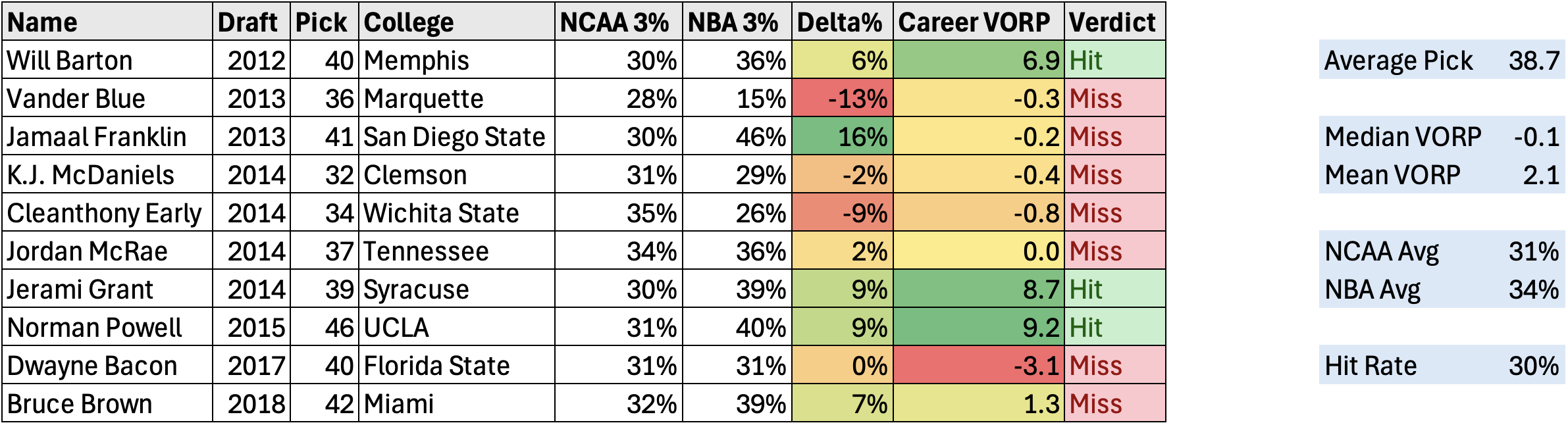
Small sample size caveats obviously apply, but at first glance this looks rough. The guys who add a jump shot to their arsenal generally have productive NBA careers, but they fail at adding said jumper at a high enough rate to keep their career value above replacement level on aggregate. Interestingly enough, despite being drafted in the 1st round, Bruno Caboclo would fit right in with this group in terms of career outcome. To be honest, this is about what I expected: 2nd round picks play like 2nd round picks, regardless of player skillset, and Powell is the outlier instead of the rule when it comes to athletic college scorers adding a jump shot in the NBA.
Now, for a treat, let’s check in on prospects who were the exact opposite. Below I have used the same process as above to select another group of prospects who were great college scorers off the back of their high volume and percentage 3-point shooting who were drafted in the 2nd round around the same pick as Powell and the rest of the above non shooters. Conventional wisdom says they should have a lower ceiling but be more consistent in being a pro success:
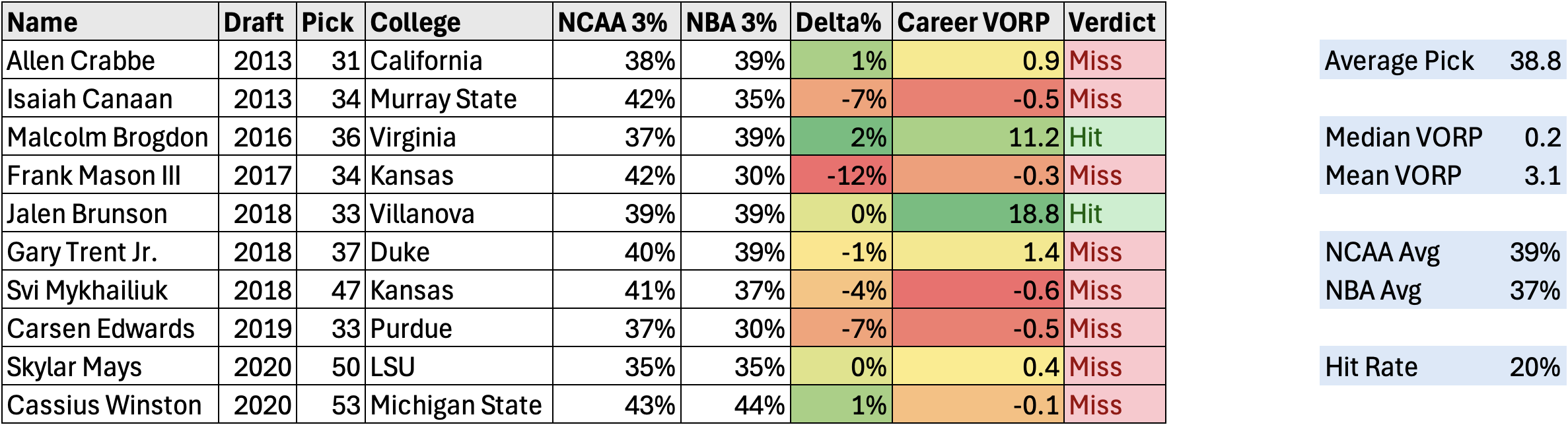
This group has a slightly higher ceiling and slightly lower hit rate but overall has just about exactly the same expected career value, despite big successes like 2016-17 NBA Rookie of the Year Malcolm Brogdon and 2025-26 NBA Champion Jalen Brunson. The shooters group has a slightly different production shape than the non-shooters, but ultimately about the same total amount. There does not seem to be any indication here that shooters have higher floors and are therefore more valuable as late round picks. Again, we see that 2nd round picks are usually chosen there for a reason regardless of archetype or profile, and I think this gets to the crux of the issue here in the modern NBA. There does not appear to be much market inefficiency to exploit in drafting in the late picks when looking purely at the numbers.
Where the exploitable inefficiency appears now is in the coaching and development aspect of the game, and the people behind the scenes. This is becomingly increasingly true for the world at large as well. The numbers are becoming about as optimized as they can be, which is funnily enough giving humanity back its upper hand. Consumer surplus is being eliminated with extreme efficacy, which has led to diminishing returns on analytical tools. Look no further than the growing popularity of the buy-and-forget Boglehead approach to investing, whereby investors treat investing as a solved problem and simply buy broad-market index funds and let them sit untouched until cash is needed rather than attempting to actively pick individual winning stocks over shorter time horizons, trusting that CAPM will hold and the ever-efficient stock market will outperform individual stock picking over the long term (they are almost definitely correct). Humans are the ones driving bigger gains these days. Once the prerequisite statistical profile is met among potential draft selections, executives need to start looking at these prospects as people.
Norman Powell is first and foremost a human being, with a unique personality and traits. Quantifying his ability to fix his broken jumper thanks to his coachability when it came to jump shooting was pretty much impossible, but Raptors brass knew what they saw and heard and had to get him in their system, even when he was drafted initially by another team. I came into this piece wanting to write about how to wring value out of 2nd round picks using a statistical analysis and came out of it with a newfound appreciation for the work done by the people with boots on the ground. This is not to say that analytical models do not have their place, as without them we would have never reached this equilibrium to begin with, but that there should be a balance maintained between the two. Again, this does not just hold true for basketball and 2nd round draft picks, but for life in general. Sometimes, your gut is actually right.
All data from Basketball Reference through the end of the 2025-2026 season.